 kptltd00m
a95d1fbd35
kptltd00m
a95d1fbd35
- Replace Librewolf with Firefox as the backup browser
- Update default and extra locales to en_US.UTF-8 and de_DE.UTF-8 respectively
- Change theme fetch setting from 'none' to 'fastfetch' and update wallpaper
- Minor formatting cleanup in THEMES.md
Nixy Pro Configuration Guide
Nixy Pro is a modular, comprehensive NixOS configuration that unifies system management across multiple hosts with consistent theming, security, and automation. This repository provides:
- 🖥️ Multi-host management (laptop, workstation, server)
- ⚙️ Hardware-specific configurations (AMD/Nvidia graphics, Bluetooth, audio)
- 👥 User-level management via home-manager with predefined user groups
- 🔒 Secure defaults (USBGuard, sudo restrictions, authentication)
- 🌈 Consistent theming with Stylix and Base16
- 📦 Package management with curated software groups
- 🐳 Container support with Docker integration
- ⌨️ Unified input methods with Fcitx5
- 🎮 Wayland ecosystem with Hyprland and tuigreet display manager
📋 Table of Contents
- 🏠 Project Architecture
- ⚙️ System Configuration Modules
- 👥 User Groups & Package Groups
- 🖥️ Host Configurations
- 🌐 Self-Hosted Services
- 🎨 Theming System
- 🛠️ Installation Guide
- 🔧 Usage & Maintenance
- 💡 Troubleshooting
- 📚 Further Reading
🏠 Project Architecture
Nixy Pro follows a multi-layer modular architecture:
.
├── flake.nix                      # Main flake outputs and inputs
├── README.md                       # This file
├── LICENSE                         # MIT License
├── hosts/                         # Host-specific configurations
│   ├── laptop/                    # Laptop configuration
│   ├── home-pc/                   # Home workstation configuration
│   ├── work/                      # Work computer configuration
│   └── server/                     # Self-hosted server configuration
├── home/                          # User-level configurations
│   ├── programs/                  # Home-manager programs and modules
│   │   ├── group/                 # Package groups (dev, cybersecurity)
│   │   ├── nvf/                   # Neovim configuration (nvf)
│   │   ├── shell/                 # Shell utilities and configuration
│   │   └── ...
│   └── system/                    # System-level user settings
│       ├── caeblestia-shell/      # Caelestia shell theme
│       └── ...
├── nixos/                         # Core system configuration modules
│   ├── amd-graphics.nix           # AMD GPU configuration
│   ├── audio.nix                  # PipeWire audio server setup
│   ├── bluetooth.nix              # Bluetooth hardware support
│   ├── docker.nix                 # Docker container runtime
│   ├── fonts.nix                  # Font management (30+ fonts)
│   ├── hyprland.nix              # Hyprland Wayland compositor
│   ├── nix.nix                   # Nix package manager configuration
│   ├── nvidia.nix                 # Nvidia GPU configuration with Wayland
│   ├── omen.nix                  # HP Omen laptop RGB control
│   ├── systemd-boot.nix           # systemd-boot loader configuration
│   ├── tuigreet.nix               # Tuigreet display manager
│   ├── usbguard.nix               # USB device authorization
│   ├── users.nix                  # User and group definitions
│   └── utils.nix                  # Utility services and configurations
├── server-modules/                # Server-specific NixOS modules
│   ├── adguardhome.nix            # DNS ad-blocker
│   ├── arr.nix                    # Media management stack
│   ├── cloudflared.nix            # Cloudflare tunnel
│   ├── cyberchef.nix              # Cyber Swiss Army Knife
│   ├── fail2ban.nix              # Security: brute force prevention
│   ├── glance/                    # System dashboard
│   ├── mealie.nix                # Recipe manager
│   ├── ssh.nix                    # SSH server configuration
│   └── ...
├── themes/                        # Visual theme configurations
└── docs/                          # Documentation directory
Architecture Layers
| Layer | Description | Example |
|---|---|---|
| flake.nix | Defines all flake outputs and inputs | Hyprland, Stylix, SOPS |
| /nixos | Core system-level NixOS modules | GPU, audio, bluetooth |
| /home | User-level configurations via home-manager | Terminals, shell, editors |
| /hosts | Host-specific configurations | laptop, workstation, server |
| /server-modules | Server services and network infrastructure | AdGuard, Glance, CyberChef |
| /themes | Theme definitions and color schemes | Rose-pine, sorbet, catppuccin |
⚙️ System Configuration Modules
Core System Modules
1. Nix Package Manager (nixos/nix.nix)
Purpose: Centralized Nix configuration across all hosts
Key Features:
- Unfree packages enabled (required for Nvidia drivers)
- Cachix mirrors configured:
https://hyprland.cachix.org(Hyprland packages)https://nix-community.cachix.org(Community packages)https://numtide.cachix.org(Numtide packages)https://cuda-maintainers.cachix.org(CUDA packages)
- Experimental features:
nix-commandandflakesenabled - Automatic garbage collection: Weekly cleanup, 7-day threshold
- Sudo configuration:
- Passwordless sudo for
nixos-rebuildcommand - Timestamp timeout set to -1 (passwordless during SSH sessions)
- Passwordless sudo for
- Download optimization: 250 MB buffer size for faster installations
2. Systemd Boot Loader (nixos/systemd-boot.nix)
Purpose: UEFI boot management with silent/ Plymouth-capable boot
Configuration:
- Bootloader: systemd-boot (supports 8 entries)
- Kernel parameters for silent boot:
quiet- Minimize console outputsplash- Show boot splash screenrd.systemd.show_status=false- Hide systemd statusudev.log_priority=3- Reduced logging level
- Kernel:
linuxPackages_latestfor cutting-edge hardware support - Cleanup: Temporary files cleared on boot
3. Users & Authentication (nixos/users.nix)
Purpose: User account management and permissions
Configuration:
- Default shell: Zsh (configured via home-manager)
- User groups:
wheel- Sudo privilegesnetworkmanager- Network control
- Multi-machine support: Variables replace hardcoded usernames
- Zsh autocompletion: System packages available in shell
Hardware & Peripherals
4. Graphics Configuration (Choose one based on hardware)
Option A: AMD Graphics (nixos/amd-graphics.nix)
Purpose: Enable AMD GPU acceleration with VA-API support
Features:
- ROCm support:
rocmPackages.clr.icdfor compute workloads - VA-API acceleration: Hardware video decoding
libvdpau-va-gl- VDPAU driver with VA-GL backendlibva-vdpau-driver- VA-API to VDPAU bridge
- OpenGL acceleration: Mesa packages for 2D/3D acceleration
Option B: Nvidia Graphics (nixos/nvidia.nix)
Purpose: Proprietary Nvidia driver setup for optimal performance
Hardware Support:
- Wayland compatibility:
nvidia-drm.modeset=1for direct rendering - Hybrid graphics: Prime offloading for laptops with multiple GPUs
- Graphics features: G-Sync, VRR, GPU-accelerated Electron apps
- API support: Vulkan, VA-API, GLX, OpenGL
Environment Configuration:
LIBVA_DRIVER_NAME=nvidia          # VA-API acceleration
GBM_BACKEND=nvidia-drm             # Graphics backend
__GLX_VENDOR_LIBRARY_NAME=nvidia   # OpenGL acceleration
NIXOS_OZONE_WL=1                  # Electron Wayland support
__GL_GSYNC_ALLOWED=1              # G-Sync support
__GL_VRR_ALLOWED=1                # Variable Refresh Rate
MOZ_ENABLE_WAYLAND=1              # Firefox Wayland
NVD_BACKEND=direct                 # New driver backend
BLACKLISTED MODULES: nouveau to prevent driver conflicts
5. Audio System (nixos/audio.nix)
Purpose: Modern audio daemon stack with hardware acceleration
Configuration:
- PipeWire enabled as default audio server (replaces PulseAudio)
- WirePlumber for session and policy management
- Alsa backend with 32-bit application support
- JACK compatibility layer for professional audio tools
- Camera monitoring disabled for privacy
- Real-time scheduling:
rtkitfor performance
6. Bluetooth (nixos/bluetooth.nix)
Purpose: Bluetooth hardware support with persistent power state
Configuration:
- Bluetooth hardware: Enabled and powered on at boot
- Standard profiles: A2DP, HFP, HID, etc.
7. USBGuard (nixos/usbguard.nix)
Purpose: USB device authorization framework for security
Configuration:
- Default policy: Block implicit (unknown) USB devices
- IPC access: Allowed for root and configured user
- Security layer: Prevents unauthorized USB devices from mounting
8. HP Omen Laptop Support (nixos/omen.nix)
Purpose: Specialized configuration for HP Omen gaming laptops
Features:
- RGB control: Kernel module
hp-wmifor custom lighting - RGB zones: 4 zones with custom access (
/sys/devices/platform/hp-wmi/rgb_zones/zoneXX) - User group:
omen-rgbfor RGB management permissions - Sysfs permissions: Set via tmpfiles rules and udev rules
- Kernel command line:
hp_wmi.force_slow_fan_control=1for battery-friendly fan control
👥 User Groups & Package Groups
Predefined Software Groups
Nixy Pro includes two main package groups for quick environment setup:
🔬 Cybersecurity Group
Purpose: Security research, penetration testing, and digital forensics
Package Categories:
- Web: dirb, ffuf, katana, whatweb
- Hashes & Cracking: hashcat, haiti, hydra, john
- Databases: mariadb, redis, sqlmap, nosqli
- Network: inetutils, termshark (TUI Wireshark), dnsrecon, whois, dig, nmap, samba
- Exploitation: metasploit, nuclei
- VPN: openvpn
- Secrets: trufflehog
- Forensics: binwalk
- Additional: spilltea, jwt-tui (from NUR package collection)
Quick Install (without full system setup):
nix shell github:anotherhadi/nixy#cybersecurity
Packages Available: 22+ security tools curated for penetration testing and security research
💻 Development Group
Purpose: Development environment with essential tools
Package Categories:
- Languages: Go, Node.js, Python 3
- Build Tools: gcc, jq, rsync
- Development Utilities: air (Go live reload), duckdb (SQLite-compatible DB), nix-prefetch-github
- Editors: claude-code (CLI for Claude), bash tools
Quick Install (without full system setup):
nix shell github:anotherhadi/nixy#dev
Packages Available: 9+ essential development tools
Home-manager User Groups
Users automatically receive:
- NetworkManager integration (GUI network configuration)
- Sudo access (passwordless for wheel group)
- Zsh shell with completions
- Caelestia-shell (Hyprland-compatible desktop environment)
- Input method: Fcitx5 for international keyboard layouts
- XDG compliance with proper directory structure
🖥️ Host Configurations
Supported Host Types
Nixy Pro manages four distinct host configurations:
| Host | Type | Hardware Profile | Network Configuration |
|---|---|---|---|
h-laptop |
Personal laptop | AMD/Nvidia GPU | NetworkManager, mobile broadband |
h-work |
Work computer | Unknown (configurable) | NetworkManager, VPN |
jack |
Self-hosted server | Server-grade hardware | Static IP, Cloudflare Tunnel |
Host Configuration Structure
Each host includes:
hosts/<hostname>/
├── flake.nix                 # Host-specific flake
├── configuration.nix         # System configuration imports
├── hardware-configuration.nix  # Auto-generated hardware config
├── variables.nix             # Host-specific variables
├── variables.secret          # Encrypted secrets (via SOPS-nix)
└── secrets/                  # Unencrypted secrets if not using SOPS
Example configuration.nix:
{
  imports = [
    # Core system modules
    ../../nixos/nix.nix
    ../../nixos/systemd-boot.nix
    ../../nixos/users.nix
    ../../nixos/utils.nix
    ../../nixos/audio.nix
    ../../nixos/bluetooth.nix
    ../../nixos/docker.nix
    ../../nixos/amd-graphics.nix  # or nvidia.nix
    ../../nixos/fonts.nix
    ../../nixos/hyprland.nix
    ../../nixos/tuigreet.nix
    ../../nixos/usbguard.nix
  ];

  # Host-specific variables
  cfg = import ./variables.nix { inherit inputs pkgs; };
}
Variable System
All hosts use centralized variables defined in variables.nix:
{
  hostname = "laptop";                # Machine hostname
  username = "hadi";                 # Main user account
  keyboardLayout = "us,de";           # Keyboard layouts
  timeZone = "Europe/Berlin";         # System timezone
  defaultLocale = "en_US.UTF-8";     # Primary locale
  extraLocale = "de_DE.UTF-8";       # Secondary locale
  autoGarbageCollector = true;         # Nix garbage collection enabled
  autoUpgrade = true;                 # Auto-update enabled
  configDirectory = "/etc/nixos";      # Config location
  flake = "/etc/nixos";              # Flake path
}
🌐 Self-Hosted Services
The server configuration (hosts/server/) includes modular service definitions for:
🔧 Server Architecture
Cloudflare Tunnel as the secure gateway with:
- Zero public IP exposure - Only accessible via Cloudflare
- Access control via Cloudflare's Zero Trust policies
- Custom domain support for easy access
📦 Services Modules
| Module | Purpose | Technology |
|---|---|---|
adguardhome.nix |
Network-wide ad blocking and DNS filtering | AdGuard Home |
arr.nix |
Media management stack (movies/TV shows automation) | Radarr, Sonarr, etc. |
cyberchef.nix |
Cyber Swiss Army Knife for data manipulation | Node.js web app |
fail2ban.nix |
Security: brute force prevention | Fail2Ban |
firewall.nix |
Network filtering and protection | systemd, nftables |
glance/ |
System monitoring dashboard | Glance |
mealie.nix |
Self-hosted meal planning and recipe management | Mealie |
stirling-pdf.nix |
Web-based PDF editor and converter | Node.js |
ssh.nix |
Secure remote access | OpenSSH |
🌐 High-Priority Services
- NGINX - Reverse proxy routing traffic to services
- AdGuard Home - Block ads/trackers at DNS level
- Glance - System monitoring dashboard
- Arr Stack - Automated media management (Radarr, Sonarr, etc.)
- Mealie - Recipe manager for meal planning
- Stirling-PDF - Client-side PDF editing/manipulation
- CyberChef - Encryption, encoding, and data analysis
- Mazanoke - Image processing and optimization
- Cloudflared - Secure tunnel via Cloudflare
- Fail2Ban - Intrusion prevention and brute force blocking
📊 Security Features
- Cloudflared: Encrypted tunnel with authentication
- Fail2Ban: IP blocking after failed login attempts
- Firewall: nftables-based filtering
- Port forwarding: Only essential ports exposed via reverse proxy
- Timed access: Scheduled firewall rules
- Network isolation: Docker networks isolated
🎨 Theming System
Stylix Integration
Nixy Pro uses Stylix for consistent theming across:
- Hyprland (WM colors)
- Terminal emulators
- GTK applications
- Rofi/Waybar/menu styling
- Shell prompts
Available Themes
See THEMES.md for theme configurations and screenshots.
Theme Gallery Examples
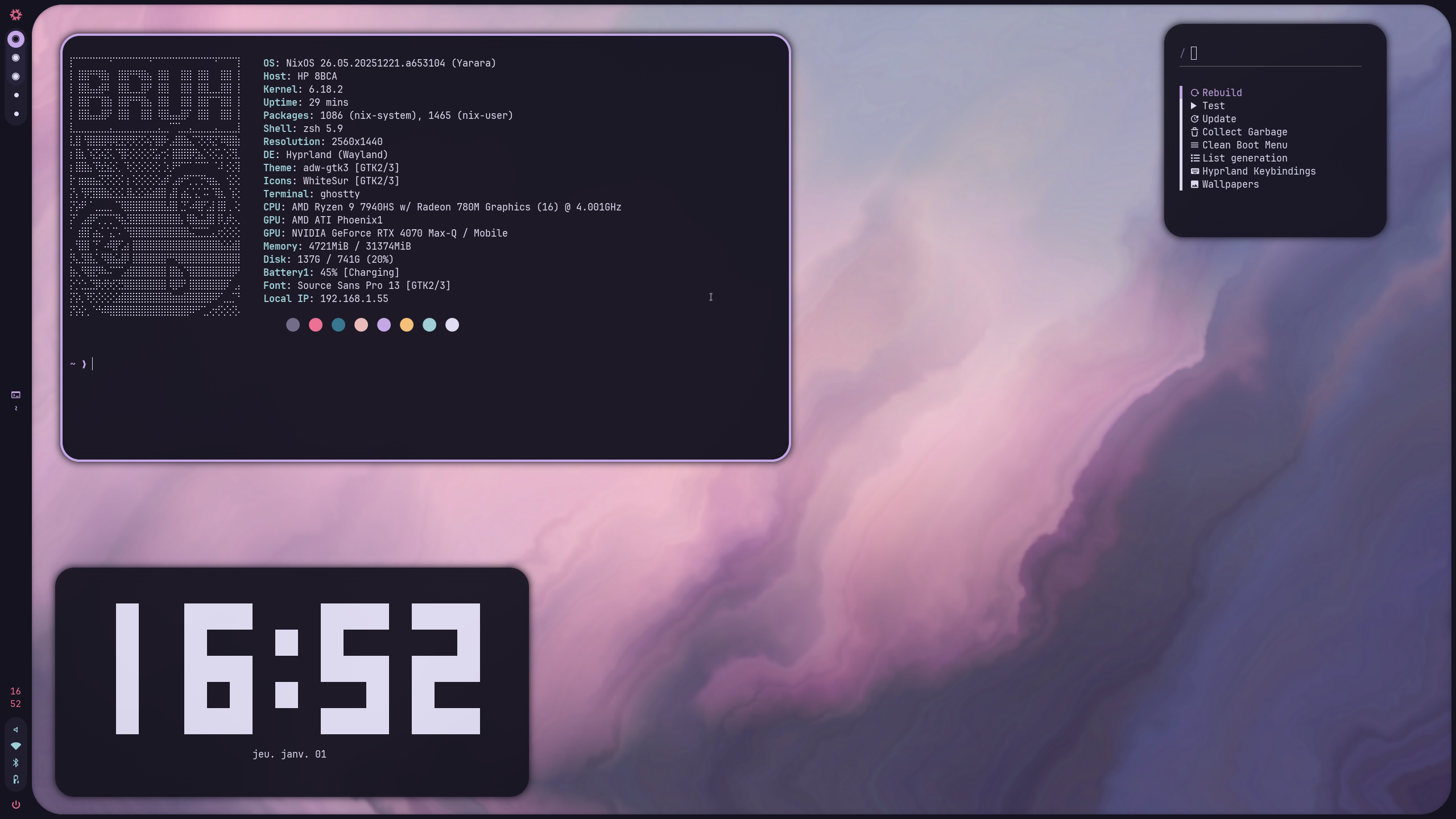 Rose-pine theme showcasing consistent color scheme across applications
⚙️ Service Configuration Layer
Essential System Services
| Service | Purpose | Configuration File |
|---|---|---|
| NetworkManager | Network configuration GUI | utils.nix |
| dbus-broker | Desktop Bus implementation | utils.nix |
| GNOME Keyring | Password storage | utils.nix |
| UDisks2 | Removable media management | utils.nix |
| Upower | Battery monitoring | utils.nix |
| Power Profiles Daemon | Power management profiles | utils.nix |
| GVFS | Virtual file system support | utils.nix |
| libinput | Touchpad/trackpoint input | utils.nix |
| dconf | Desktop configuration storage | utils.nix |
| Greetd + Tuigreet | Display manager | tuigreet.nix |
| XDG Portal | File picker and portal integration | utils.nix |
Font Management
30+ fonts installed including:
- Sans-serif: Roboto, Work Sans, Source Sans, Comfortaa, Inter, Jost, Lexend
- Serif: Comic Neue
- Monospace: Fira Code (Nerd Font), Meslo LG (Nerd Font)
- Default: DejaVu, Noto (including CJK and color emoji)
- Special: OpenMoji, Twemoji
Note: Default font packages disabled to allow user selection via home-manager
🛠️ Installation Guide
Prerequisites
- NixOS System (latest stable or unstable)
- Git and sudo access
- Internet connection for package downloads
- Disk space: Minimum 30GB recommended for full installation
- UEFI system (systemd-boot requirement)
Installation Steps
Step 1: Clone the Repository
# Recommended location for NixOS configurations
git clone https://gitea.doomlabs.de/KptltD00M/nixy.git /etc/nixos
cd /etc/nixos
Step 2: Copy Appropriate Host Configuration
# Choose your hardware profile:
# - Laptop (AMD/Nvidia)
# - Home workstation
# - Work computer
# - Server

# For example, if setting up a laptop:
cp -r hosts/laptop hosts/$(hostname)

# Navigate to new host configuration
cd hosts/$(hostname)
Step 3: Configure Host-Specific Variables
# Edit host variables
nano variables.nix
Change CHANGEME values:
hostnameusernamekeyboardLayouttimeZonedefaultLocale
Step 4: Set Up Secrets
# Either:
# Option A: Use SOPS-nix for encrypted secrets (recommended)
pdo export secrets/ > secrets/secrets.yaml.age
../../bin/update-secrets

# Option B: Manual secrets
# Copy secrets template if needed
cp -r hosts/laptop/secrets hosts/$(hostname)/secrets
Step 5: Review and Apply Configuration
- Check for CHANGEME comments:
# Quick scan for required changes
rg "CHANGEME" /etc/nixos
- Verify hardware configuration:
# Import appropriate GPU module in configuration.nix
# - AMD: ../../nixos/amd-graphics.nix
# - Nvidia: ../../nixos/nvidia.nix
# - HP Omen: ../../nixos/omen.nix
- Apply configuration:
# Dry run first
sudo nixos-rebuild dry-activate --flake .#$(hostname)

# Apply
sudo nixos-rebuild switch --flake .#$(hostname)
Step 6: Home-manager Setup
# Update home-manager configuration
home-manager switch --flake /etc/nixos#$(username)@$(hostname)

# Optional: Generate hardware configuration if rebuilding from scratch
sudo nixos-generate-config --root /mnt
🔧 Usage & Maintenance
Daily Commands
| Command | Purpose |
|---|---|
sudo nixos-rebuild switch --flake .#laptop |
Rebuild and apply system changes |
home-manager switch --flake .#hadi@laptop |
Update home-manager configuration |
sudo nixos-rebuild boot --flake .#laptop |
Set new generation as default boot |
nix flake update |
Update flake inputs |
sudo nixos-rebuild switch --upgrade |
Update system and packages |
nix store gc |
Cleanup unused packages |
nix profile list |
List installed packages |
nix profile wipe-history |
Remove old package versions |
Flake Update Process
# Update all flake inputs
nix flake update

# Rebuild all systems
for host in h-laptop h-work jack; do
  sudo nixos-rebuild switch --flake .#$host
done

# Update home-manager
for host in h-laptop h-work jack; do
  home-manager switch --flake .#username@$host
done
System Updates
Automatic Updates Enabled:
system.autoUpgrade = {
  enable = true;                # System updates
  dates = "04:00";            # Daily at 4 AM
  flake = config.var.configDir; # Self-update
  flags = ["--update-input" "nixpkgs"];
  allowReboot = false;          # Manual reboot required
};
Recommendation: Check system status weekly:
systemctl status --user wireplumber pulseaudio-esd autostart-vpn
journalctl --vacuum-time=7d
💡 Troubleshooting
Common Issues & Solutions
❌ Audio not working
Diagnosis:
- PipeWire service status
- WirePlumber activity
- Audio device detection
Solutions:
# Check PipeWire status
systemctl --user status wireplumber pulseaudio-esd

# Verify audio devices
pw-cli list-objects | grep -i audio

# Restart audio services
systemctl --user restart wireplumber
❌ Hyprland fails to start
Symptoms:
- Black screen after login
- Wayland session crash
- Missing display manager
Diagnosis:
- XDG_RUNTIME_DIR environment
- PipeWire running
- Required files present
Solutions:
# Check environment
echo $XDG_RUNTIME_DIR
whoami                             # Should be logged-in user

# Verify services
systemctl --way status
ls /run/current-system/sw/share/wayland-sessions/
Manual start:
$XDG_RUNTIME_DIR=/run/user/$(id -u) Hyprland
❌ Nvidia drivers not loading
Diagnostics:
- Kernel parameters check
- Secure boot status
- Driver conflicts
Common fixes:
# Check kernel parameters
cat /proc/cmdline | grep nvidia

# Verify module loading
lsmod | grep nvidia

# Blacklist nouveau (if not already done)
echo "blacklist nouveau" | sudo tee /etc/modprobe.d/blacklist-nouveau.conf
sudo update-initramfs -u -k all
Secure boot workaround (if enabled):
- Disable secure boot in BIOS
- Or sign Nvidia modules
⚠️ Home-manager not applying changes
Solutions:
# Check home-manager configuration
home-manager build --flake /etc/nixos#username@hostname --show-trace
home-manager generations

# Force fresh rebuild
rm -rf ~/.local/share/nix/profiles/home-manager
home-manager switch --flake /etc/nixos#username@hostname
🔄 USB devices blocked by USBGuard
Diagnosis:
- USBGuard service status
- Policy decisions
Solutions:
# Check USBGuard status
systemctl status usbguard

# List USB devices
lsusb

# Temporarily allow device
usbguard list-devices
usbguard allow-device <device-id>
Configuration: Edit /etc/usbguard/rules.conf for permanent changes
System Recovery
If system fails to boot:
- Reboot into recovery ISO
- Remount root partition
- Apply configuration:
sudo nixos-rebuild switch --flake /etc/nixos#hostname
If home-manager breaks:
# Reinstall from scratch
home-manager uninstall
home-manager switch --flake /etc/nixos#username@hostname
📚 Further Reading & Resources
NixOS Documentation
- NixOS Manual - Official NixOS documentation
- Nix Flakes Guide - Flakes feature documentation
- Home Manager Manual - User-level configuration
Related Projects
- Hyprland - Wayland compositor
- Stylix - Theming system
- Caelestia Shell - Desktop environment
- SOPS-nix - Secret management
- Helium Browser - Flutter-based browser
Repository Documentation
- GROUPS.md - Package groups (dev, cybersecurity) and how to use them
- SERVER.md - Server-specific service configurations
- NEOVIM.md - Neovim configuration (nvf)
- THEMES.md - Theme system and color schemes
- CONTRIBUTING.md - Contribution guidelines
Useful Commands Reference
# Show generation history
sudo nix-env --list-generations

# Switch to specific generation
sudo nixos-rebuild switch --flake .#laptop --profile /nix/var/nix/profiles/system-<generation>

# Rollback to previous generation
sudo nix-env --rollback
sudo nixos-rebuild switch

# Clean old generations (keep 5 latest)
sudo nix-collect-garbage -d
sudo nix-env --delete-generations old